The last entry on my blog was about the beautiful, natural scenery of the Atlas Mountains. Here are some glimpses of the actual cities / mountains towns in that area. I found that many were utilitarian and not picturesque or decorative : beautiful as foregrounds to mountainous vistas, but surprisingly bland once you were there.
AÏT BENHADDOU
The kasbah in Aït Benhaddou is one the best preserved in Morocco; it is a UNESCO-protected site and has been used in over 20 films (including Lawrence of Arabia, Jesus of Nazareth, Jewel of the Nile, Kingdom of Heaven and Gladiator). Unfortunately, I did not get to see this city up-close: we intended on stopping on our return, but the road looped around elsewhere and we just didn't make it back.
The kasbah in Aït Benhaddou is one the best preserved in Morocco; it is a UNESCO-protected site and has been used in over 20 films (including Lawrence of Arabia, Jesus of Nazareth, Jewel of the Nile, Kingdom of Heaven and Gladiator). Unfortunately, I did not get to see this city up-close: we intended on stopping on our return, but the road looped around elsewhere and we just didn't make it back.

Palm gardens, like this one near Aït Benhaddou, are called ''palmeraies''. A stony desert (as opposed to a sandy desert) is called a ''hammada''.

OUARZAZATE (pron. WAR-za-zat)
Probably the most well-kept city so far. A lot of money spills into this place from the bustling movie industry. Once the sun went down, people came out to the main square in droves to see and be seen. One observation : Groups of girls never walked with groups of boys; they always kept their distance and never mingled.
Probably the most well-kept city so far. A lot of money spills into this place from the bustling movie industry. Once the sun went down, people came out to the main square in droves to see and be seen. One observation : Groups of girls never walked with groups of boys; they always kept their distance and never mingled.

They don't only make tajines in tajine earthenware; they also make omelettes! My breakfast at the hotel in Ouarzazate.

One of many movie studios that we drove by. ''Ouallywood'' has been quite busy providing backdrops for movies whose storylines take place in exotic locations, like Tibet, Egypt, ancient Rome, anywhere in Africa or the Middle East....

ZAGORA
Zagora used to be the most important trading post for camel caravans traveling through the Sahara. In fact, the iconic ''Timbuktu, 52 days'' sign that used to hang in town was inexplicably taken down by the government. Really though, the town served as a convenient stopping point in the mountains ; we didn't find much to do there.

Zagora used to be the most important trading post for camel caravans traveling through the Sahara. In fact, the iconic ''Timbuktu, 52 days'' sign that used to hang in town was inexplicably taken down by the government. Really though, the town served as a convenient stopping point in the mountains ; we didn't find much to do there.

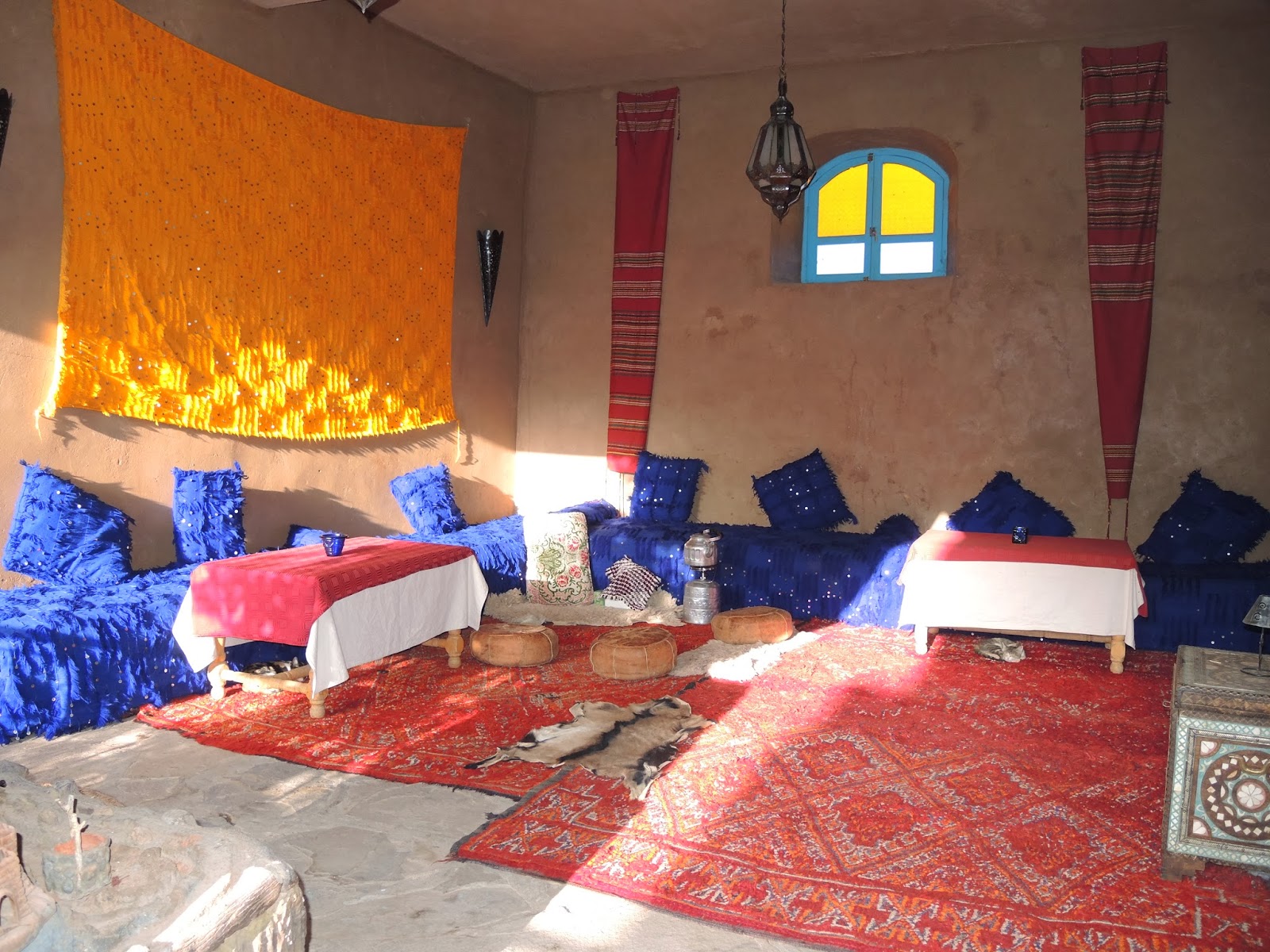
Lounging area in our hostel La Petite Kasbah
Rooftop supper at Zagora hostel. After supper, they set up cushions in a circle and all the guests sat around having tea with the staff, who were awesome! Not sure why I didn't think of taking a picture of THAT......

You know the snow fences that ski resorts build in Canada to keep snow from drifting everywhere? These are sand fences; they help to keep the towns and fields sand-free. May I also kindly suggest garbage fences?

A guide took us around Zagora and its huge date garden, where he climbed a tree to pick fresh dates for us. He was such a cute kid. Sure enough, he brought us to his family's carpet shop, from where it literally took us a full hour to politely but persistently extract ourselves. ALWAYS looking for a sale!

TELOUET
A sleepy Moroccan town that was once ruled by warlords, we drove through here to visit the famous kasbah and grab a bite to eat. The Glaoui Kasbah was built and owned by Pasha ('Governor') Thami Glaoui, who essentially sold Morocco to the French in the 1910s (that's a very simplified statement for a very complex process, obviously). When Pasha Glaoui was stripped of his title by the Morocco Independence Movement in 1953, hundreds of citizens --who had disappeared years and years before-- stumbled dazed onto the streets, having been locked up in the Pasha's basement. Many such political prisons were set up throughout the country at that time, and their existence was fully denied until 1991, when the current King decided to turn the page on Morocco's turbulent political history, and start afresh.
A sleepy Moroccan town that was once ruled by warlords, we drove through here to visit the famous kasbah and grab a bite to eat. The Glaoui Kasbah was built and owned by Pasha ('Governor') Thami Glaoui, who essentially sold Morocco to the French in the 1910s (that's a very simplified statement for a very complex process, obviously). When Pasha Glaoui was stripped of his title by the Morocco Independence Movement in 1953, hundreds of citizens --who had disappeared years and years before-- stumbled dazed onto the streets, having been locked up in the Pasha's basement. Many such political prisons were set up throughout the country at that time, and their existence was fully denied until 1991, when the current King decided to turn the page on Morocco's turbulent political history, and start afresh.

Most of Glaoui Kasbah lies in ruins, with very few Moroccans willing to donate money to preserve such a shameful relic of Morocco's French-dominated past. Understandably so.

Glaoui Kasbah's beautiful prayer room.

Such details in the plaster sculpting, woodwork and mosaic tiles


Stopped for lunch at this cute Telouet restaurant....

... where we ate a tajine in a Berber tent filled with carpets and cushions.

IMLIL
The last mountain town we visited was Imlil, tucked away deep into the highest Atlas Mountains range, not far from the ski resort. Perched at 1740 meters, it was an awesome little place in which to wake up. It was also a good base from which to explore the surrounding mountains, both by car and by foot.

Heading into the High Atlas valley... The ski resort (Oukaïmeden) has already started to get a bit of snow (top right).

Here we are! The lovely town of Imlil.

Our hostel room in Imlil, complete with 2 traditional Berber bathrobes....

..breakfast tea nook.....

... and wood-burning chimney.

We drove to the town of Armoud (pictured), then shared the rocky hiking trail with locals and donkeys for a few hours.

The village of Sidi-something (sorry, lost the topo map with the name of the village!), quite high up into the mountain trail. We stopped for tea on the way down at the southernmost tea shop (bottom left).

A good place to enjoy sweet mint tea and a smoke on the ol' pipe.

Tomorrow we head back to Marrakesh for a day to drop off the rental car, then taking a bus to the Atlantic Coast to visit a spot called Essaouira. Many thanks for reading and for your awesome comments; I'm having fun relating my trip back to you!


